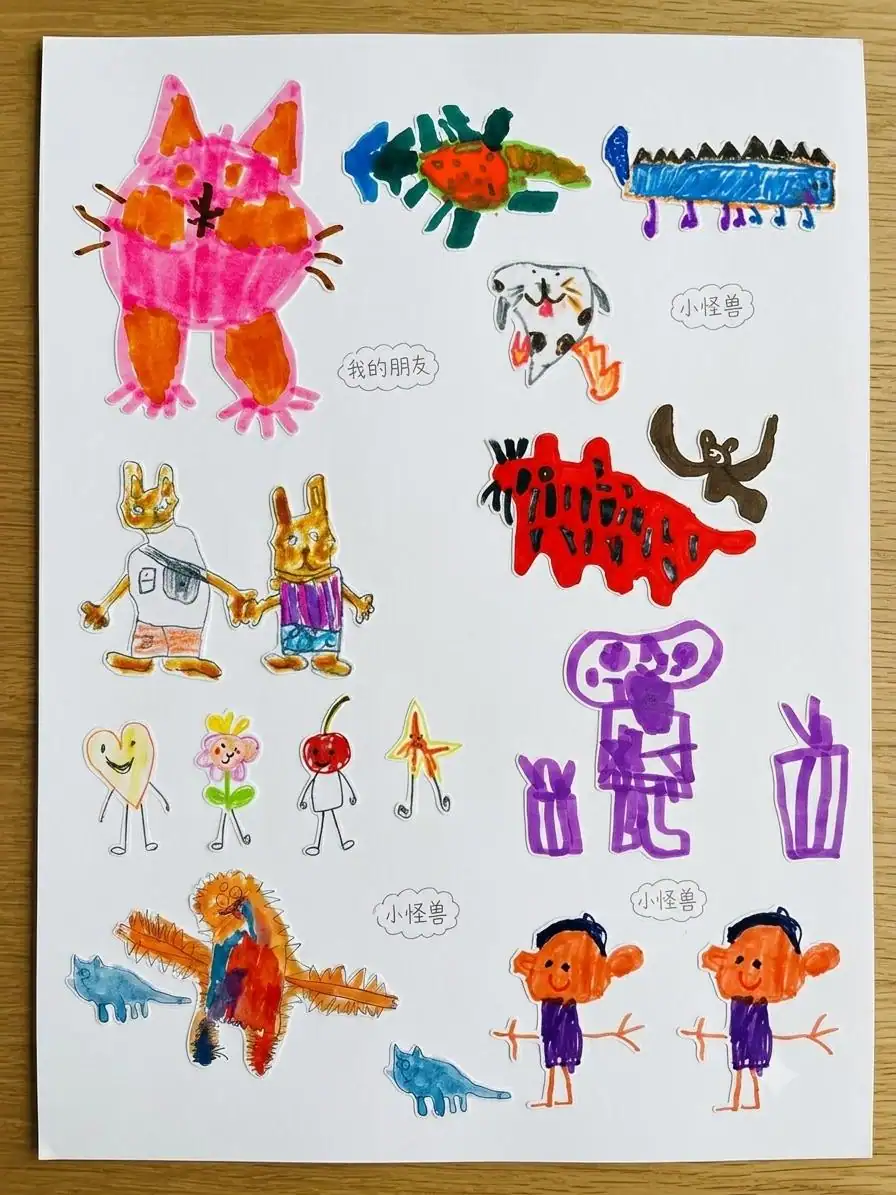
The drawing belongs to your child
A scribble, a carefully drawn animal or an imaginary machine can all start a story. Ask your child what they see before deciding what the picture represents. The aim is to build on their idea, not replace it with an adult’s polished version.
Four invitations to tell a story
- Who is this? Let your child choose a name or describe the character.
- What do they want to do? Go to the moon, find a friend or eat a huge apple?
- What happens along the way? A surprise is enough; there does not have to be a dramatic problem.
- What happens next? Your child can change the ending whenever they like.
These are prompts, not a form to complete. A younger child may prefer to tell you about just one object. An older child may want to type the story independently.
Keep the original words
Write down what your child says in English, or let them type. Keep invented names and playful spelling in their original version. If you add a clearer reading version, show it separately and check that it still means what your child intended.
Choose one useful Chinese expression connected to the picture. For a rocket story, try 飞起来 (fēi qǐ lái, take flight). Listen together instead of expecting your child to decode pinyin as English.
A tiny example
Your child’s idea: “My cat is going to the moon.”
A short Chinese sentence: 小猫想去月亮。
Its English meaning: “The little cat wants to go to the moon.”
This is a suggested sentence, not a replacement for the child’s original words. The English and Chinese should each sound natural.
Try the drawing-to-story flow
- Draw online or upload a picture selected by an adult.
- If you want, continue creating on the uploaded artwork.
- Add your child’s words yourself, or let your child type.
- Explore relevant word cards and the available story options.
- Preview the result together. Check names, meaning and any added language before keeping it.
Do not assume every original sentence will be translated automatically. If the other language is missing or the meaning is uncertain, review it with appropriate help rather than presenting a guess as a translation. Saving and downloading depend on the account’s current access.
Return to the picture
Invite your child to add a friend, change the weather or draw another ending. Revisit a Chinese word when it is useful to describe the new detail. The story is a place to use language, not a reward for memorising a list.
Before uploading or sharing
An adult should check for real names, school details, addresses, contact information and identifying background details. Use nicknames and imaginary places. Read the children’s privacy information before choosing what to upload or share.